A False Nine and a Deep-Lying Forward: Where the Jobs Differ
False nine vs deep-lying forward: learn how each role leaves the front line, which defenders it draws, and what space teammates can attack next.
Where should you look when a striker drops away from the last line? The difference between a false nine and a deep-lying forward is clearest in the space each one is trying to create, and in the route teammates take to use it. Both can receive away from goal, but they do not ask the defense the same question.
False nine vs deep-lying forward
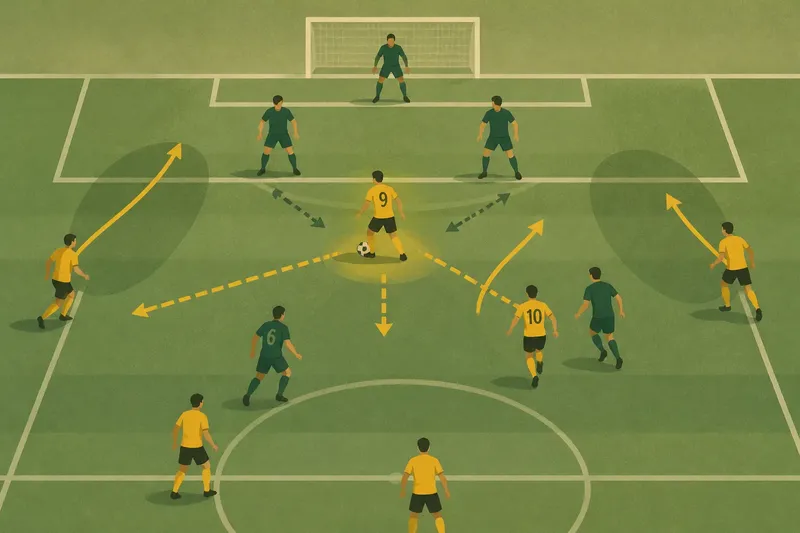
A false nine begins as the central forward, then leaves the opposition center backs without a fixed reference point. The typical movement is a sharp drop into the space between the defense and midfield. If a center back follows, a channel may open behind him; if he holds position, the false nine can receive facing forward between the lines.
The role depends on others recognizing that invitation. A winger or attacking midfielder can run into the vacated central lane, while another player might stretch the back line from wide. The false nine is not simply a striker who prefers to pass. His movement changes where defenders must decide to stand.
A deep-lying forward also comes toward the ball, but usually remains more visibly connected to the front line. He can drop to link play, shield a pass, or bring a teammate into the attack, then turn or move forward again. His presence often continues to occupy a center back, even while he receives deeper than a conventional striker would.
These are tendencies, not rigid definitions. A player can combine the behaviors, and the team’s shape, the location of the ball, and the opponent’s marking all affect what the role looks like in a given passage.
The space behind the drop
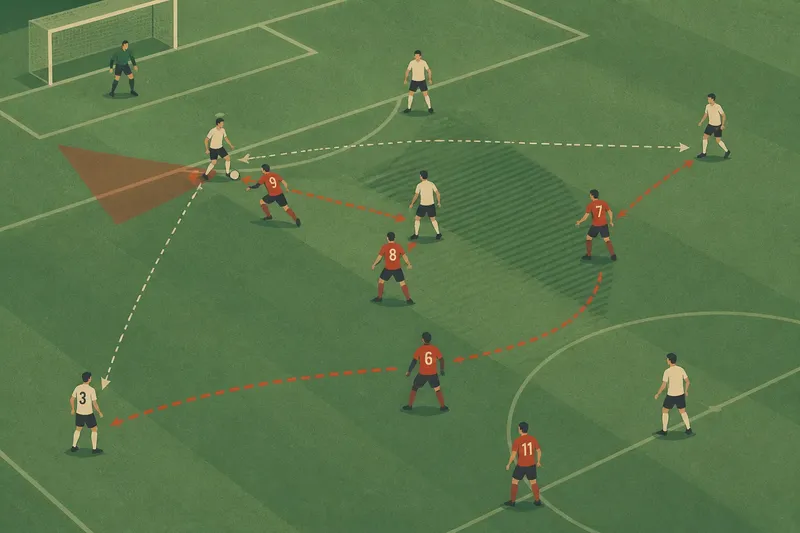
Watch the defender before judging the forward’s movement. If the false nine drops and a center back steps out, the useful space is often behind that defender, in the channel between him and the fullback. The next question is whether a teammate attacks it promptly. Without that run, the defender can step back into line and the opening disappears.
If the center backs stay home, the false nine may receive in front of them with room to turn. That can draw a midfielder toward the ball, loosening the opposition’s hold on a nearby runner. The space opened is then not necessarily a hole in the back line; it may be a passing lane or a pocket for an attacking midfielder.
A deep-lying forward more often creates a useful pocket in front of the defense while helping the team advance. A midfielder can pass into his feet, and a nearby runner can continue beyond him. The forward’s touch or layoff gives that runner a route through the middle, while the striker’s position can still occupy a defender who might otherwise step up.
Say a team is building from the left, with its winger holding the touchline and its attacking midfielder positioned inside. If the central forward drops into the gap between midfield and defense, the nearest center back must choose whether to follow. A teammate’s run into the channel he leaves is the expected next action; if nobody goes, the forward may have room to turn, but the defense has not been pulled apart in the same way.
Reading the defender’s choice
Use the center back’s feet and shoulders as clues. A defender who turns and runs toward his own goal is responding to a threat behind him. A defender who steps toward the dropping forward is trying to stop a reception between the lines. The same movement from the striker can therefore produce different outcomes, depending on the defender’s response.
Also check the distance between the forward and the nearest midfielder. A false nine receiving in a narrow pocket may draw a midfielder out and leave a teammate free beyond him. A deep-lying forward receiving with a close supporting player can combine quickly, but that short connection is useful only if someone else maintains depth.
Do not read a single drop in isolation. Follow the forward’s next movement: does he stay in midfield to help circulate the ball, spin beyond the center backs, or move toward a new angle for a return pass? Repeatedly dropping without a runner can make the team’s attack crowded in front of the defense. Repeatedly holding the line can leave the build-up without a link. The role is visible in the sequence, not just the first movement.
When does each role fit?
What is a false nine trying to open?
Usually, he is testing the space between the opposition’s midfield and defense, or the lane behind a center back who follows him. Teammates need to occupy the back line and make forward runs for that movement to threaten depth.
Does a deep-lying forward still play as a striker?
Yes. He may drop to connect passes, but he remains part of the team’s front line and can still pin a center back or move back toward goal. The label describes a role, not a fixed position on every phase of play.
Can one forward perform both roles?
A forward can show both patterns, but the team’s supporting movements determine which job is being emphasized. Look for whether the attack chiefly seeks a runner into the space behind the drop or a close combination through the forward’s feet.
What should a viewer track first?
Track the nearest center back, then the teammate who could use the space. That pairing reveals whether the drop is meant to pull a defender out, create a link, or offer the forward a chance to turn.
What not to overread
It is not worth assigning a role from a formation graphic or one touch in midfield. A center forward may drop because the pass is available, because the team needs an outlet, or because the opponent has left a pocket unguarded. Look for the repeated movement and the response it draws before settling on a label.
For the false nine vs deep-lying forward distinction, the most useful final check is what happens after the ball reaches the dropping player. If teammates attack the space he has left, the movement is helping disrupt the back line. If he mainly provides a platform for nearby passes while preserving a central target, the deep-lying-forward job is closer. The receiver’s position starts the reading; the next run completes it.