The Formation Number Does Not Tell You Who Is Pressing
Formation and pressing are different clues. Learn to read the first pressure, supporting runs, cover shadows and triggers to identify a team’s plan.
Which team is actually pressing: the one listed in a 4-3-3, or the one whose players move together to close the ball? Formation labels describe starting positions, not the full plan for applying pressure. To read a press, begin with what happens after the opponent receives possession, then follow the players whose movements make that pressure work.
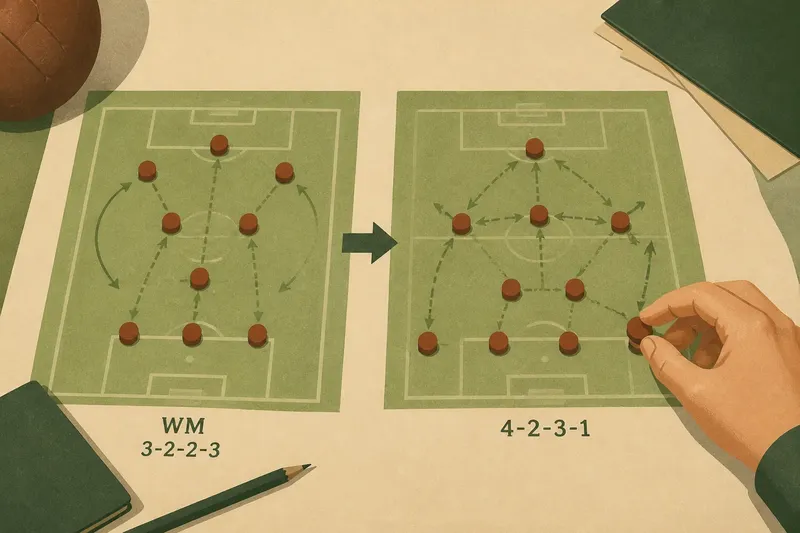
A lineup graphic may show four defenders, three midfielders and three forwards. That can help you locate players before the match, but it cannot tell you whether the wide forwards will chase fullbacks, whether a central midfielder will step up, or whether the team intends to leave a passing route open. Those details appear in motion.
Separate shape from pressure
Use “formation” for the arrangement a team adopts in a particular phase, and “pressing plan” for how it tries to disrupt the opponent’s possession. The two can relate, but they are not interchangeable. A team that begins in a 4-3-3 may defend in a 4-1-4-1, press with two forwards, or drop off and protect the space in front of its back line.
Even the label can obscure a useful distinction: a formation is often reported as a tidy arrangement, while players adjust their distances as the ball travels. The starting picture might have a forward near each touchline. If one moves inside to screen a midfielder, the pressing structure changes without the team necessarily changing its nominal formation.
For a clear read, choose a moment when the opponent has controlled the ball near its own defense. Watch the first few passes rather than trying to interpret the entire match at once. Ask who closes the ball, who blocks the next pass, and who stays behind to protect against a direct ball through the pressure.
Find the first presser
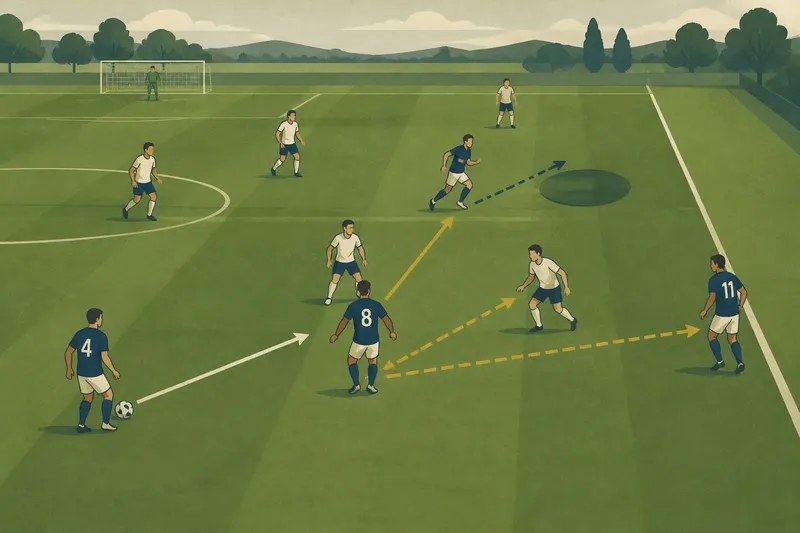
Start with the player who approaches the ball carrier. Note the distance and angle of the approach, not just whether that player runs forward. A curved run can guide the carrier toward the sideline or away from a central passing lane. A straight sprint that leaves an easy route into midfield may look aggressive without being effective pressure.
Then check whether the first presser is acting alone. A teammate may move toward the nearest central receiver, while another shifts across to guard the route to the opposite side. These supporting movements can make a modest approach more consequential: the ball carrier sees fewer safe options even before anyone attempts a tackle.
Look at the second line as well. If midfielders step forward behind the first presser, they may be trying to crowd the next pass and contest a hurried reception. If they stay deep, the team may be containing the ball carrier rather than committing to an immediate high press. One forward’s chase does not establish the whole plan.
Read the cover shadows
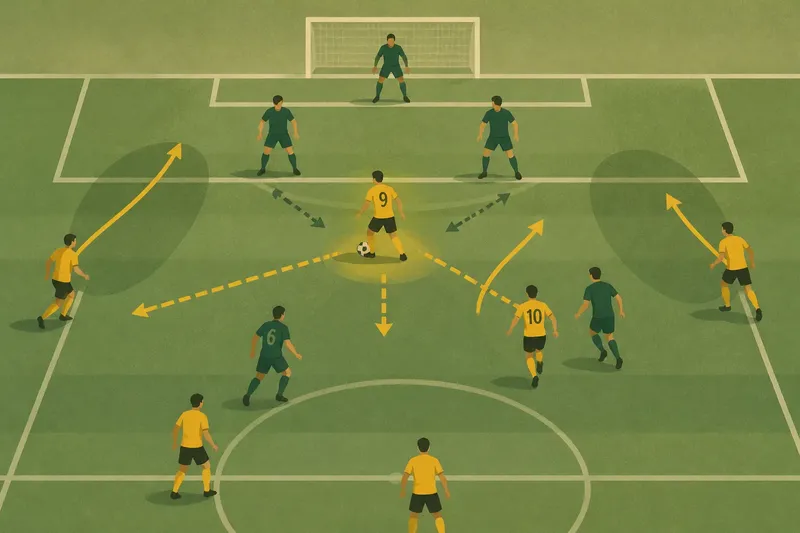
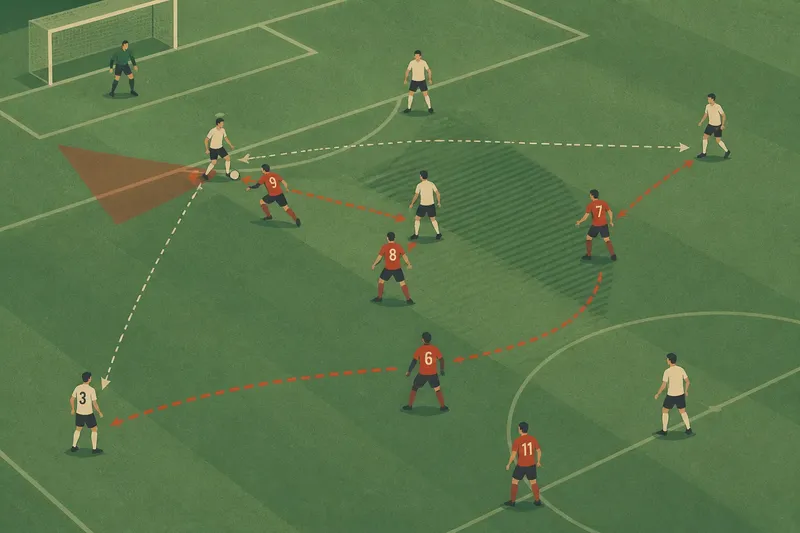
A cover shadow is the space a pressing player’s position and body angle make harder to use. If a forward closes a center back while standing between that defender and the central midfielder, the forward can discourage a pass into midfield without having to run directly at the receiver. The opponent may be steered toward a fullback, where a teammate is ready to close.
Follow the passing options the defender can still see. If the central route is screened, does the wide route remain available? If the ball goes wide, does the nearest midfielder arrive, and does the winger stay close enough to prevent an easy pass back inside? This chain reveals more about the pressing plan than the formation number does.
Do not assume every screened pass is deliberately allowed. A player may simply be late to adjust, or the team may be reorganizing after a previous movement. Look for the same relationship across several possessions before treating it as a settled pattern.
Watch for pressing triggers
Teams often apply stronger pressure when a particular event makes the opponent’s next action less comfortable. Common observable triggers include a slow pass, a receiver facing their own goal, a poor first touch, or a ball played toward the touchline. The trigger is not the same as a formation: it is the cue that prompts nearby players to move.
When one occurs, watch the nearest players together. Does the receiver get closed from the front while a teammate blocks the return pass? Do midfielders step toward the likely next receiver? Does the back line move up to reduce the space behind the midfield? A coordinated response across those lines is stronger evidence of a pressing plan than a single player’s run.
Also note when pressure stops. A team may sprint toward the ball, then retreat once the opponent escapes the trap. That can be a planned choice rather than a failed press. The aim may be to force a hurried pass or prevent a clean advance, not to win possession on every attempt.
Track the team’s response
After the first pass beats the nearest presser, keep watching. The next decision helps distinguish a committed press from a temporary approach. Defenders may step forward to compress the space, midfielders may recover into a compact block, or the forwards may keep chasing to close the next receiver. Each response changes what the opponent can do.
Pay attention to the space left behind the first line. If a team sends several players toward the ball, an opponent may try to pass into the gap behind them. A defender stepping out to challenge can leave another space elsewhere. The press is therefore a coordinated risk: the team seeks to constrain one route while its other players cover the routes that remain.
At the same time, avoid judging the plan only by whether the team wins the ball. Pressure can force a backward pass, a long clearance, or a sideways reset. Those outcomes may suit the pressing side even when possession does not change. Describe what the pressure makes difficult, rather than treating every unsuccessful tackle as evidence that no press exists.
A match-reading sequence
Use this order when you want to identify the plan without getting distracted by the lineup graphic:
- Locate the ball. Begin when the opponent has controlled possession in a recognizable area, such as beside a center back or near a fullback.
- Identify the first approach. Record who closes, the angle they take, and whether they appear to guide play toward a particular side.
- Check the next passing lane. See whether another player blocks or covers the nearest central option while the first presser approaches.
- Watch the midfield line. Note whether midfielders advance to support pressure, hold their positions, or retreat to protect space.
- Follow the opponent’s escape. If the ball reaches another player, observe whether pressure transfers, the team drops back, or the back line steps up.
- Compare repeated possessions. Look for the same cue and response on more than one occasion before describing it as a pattern.
Keep the notes plain: “forward curves toward the fullback; near midfielder closes inside pass; wide player follows the return.” That description is more useful than writing “4-3-3 press,” because it records actions another viewer can check.
What does the formation show?
Can a 4-3-3 press with two forwards?
Yes. A wide forward can move alongside the central striker to close two defenders or screen a route out. A midfielder may then shift toward the ball side, creating a pressing arrangement that does not match the lineup’s simple three-forward picture.
Does a high defensive line mean high pressing?
Not by itself. A high line reduces space behind the defense, but the team may still choose to wait before closing the ball. Look for the front players’ approach and the midfielders’ support to determine whether pressure is being applied.
Can a team press in a 4-4-2?
Yes, but the label does not explain the roles. The forwards might split their runs to screen central passes, while wide midfielders move toward the fullbacks; another team with the same nominal shape may stay compact and press only after the ball travels wide.
How many possessions should I watch?
There is no fixed count that settles the question. Compare several similar situations, such as opponent goal kicks or controlled passes to a fullback, and look for recurring movements rather than treating one chase as the team’s permanent approach.
Describe the plan precisely
Say you are watching an invented match in which the lineup graphic lists a 4-3-3. An opponent plays from its center back to the right fullback; the near forward curves toward that player, the winger blocks the pass down the line, and a midfielder steps across to screen the central receiver. If the same response appears again when the ball reaches that side, you could describe the pattern as a press that guides possession wide and closes the next pass. The formation label remains useful context, but the coordinated actions explain the plan.
It is not worth pausing every move to assign a new formation number. That can turn a fluid sequence into a string of labels without clarifying who is responsible for the pressure. Instead, name the player roles involved, the cue that prompts them, and the route they try to close.
When you next search for a team’s pressing plan, treat formation and pressure as separate clues. Start with the first approach, follow the cover behind it, and watch how the team reacts when the opponent escapes. The number tells you where players may begin; their shared movements tell you who is pressing.