Why the Third Player Can Change a Passing Triangle
See how the third player changes a passing triangle, draws a marker away and opens a forward route without forcing the ball through a crowded lane.
Why does a short pass sometimes open a forward route that was not there a moment earlier? In a football passing triangle, the third player can shift a defender’s attention and give the player on the ball another way to progress. The change is less about adding a passing option on a diagram than about making a defender choose.
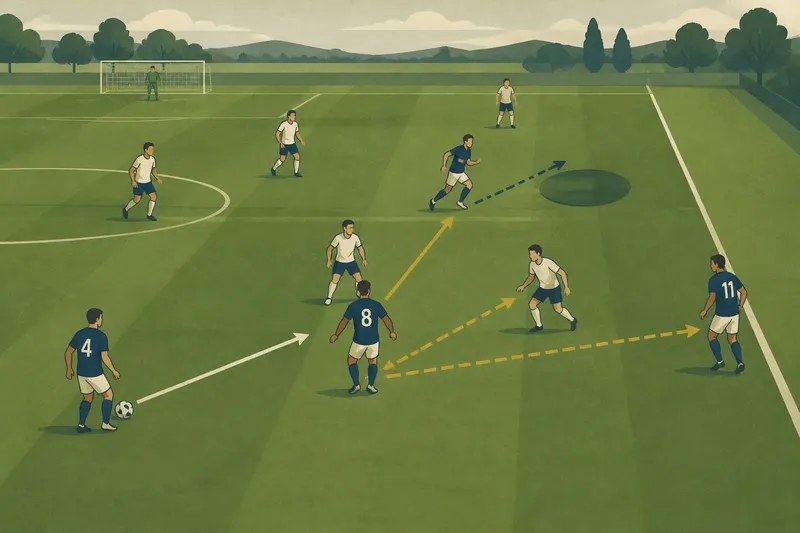
Consider one invented situation: a team has the ball near the right touchline, just beyond halfway. Its right-sided centre-back passes into a midfielder, who is facing forward but has an opponent closing from the inside. A winger waits ahead near the line. The team’s third player, a nearby forward, can either stay in the midfielder’s sightline or move into a pocket behind the pressing midfielder. That choice shapes what the defender can protect.
The crowded first picture
At the instant the midfielder receives, the apparent triangle is straightforward: centre-back, midfielder, winger. The winger is a possible forward target, but the route to him runs close to the touchline and through the defender’s pressure. If the midfielder turns toward that lane, the opponent can close the ball and angle their body to discourage the pass outside.
The midfielder could return the ball to the centre-back, preserving possession but leaving the opponent’s defensive line undisturbed. Or the midfielder could attempt a difficult pass to the winger. Neither choice is automatically wrong. The problem is that the defender can read both from the same compact picture: ball carrier, outside target and a safe pass behind.
Now the forward moves diagonally toward the inside channel, a few strides beyond the midfielder. The movement does not need to bring the forward close to the ball. Its value is that the pressing midfielder must register a player arriving in a space they might otherwise use to block a forward pass.
A third route appears
The midfielder can now play into the forward’s feet, pass wide to the winger, or recycle to the centre-back. Those routes have different purposes. The pass into the forward may draw a centre-back or holding midfielder toward the ball; the wide pass can exploit space outside; and the return pass keeps the team connected if the forward lane is closed.
The third player changes the triangle by affecting the defenders as well as offering a target. If the opponent’s midfielder follows the forward inward, the lane toward the winger may become less crowded. If the defender holds position to protect the outside pass, the forward may receive with enough room to lay the ball off. Either way, a defender has to divide attention between the ball and a player threatening a different space.
In the invented situation, the midfielder passes into the forward. The forward receives with an opponent close behind and plays a simple layoff back toward the midfielder, who has continued moving. The ball has travelled through the third player rather than directly from the original receiver to the winger. As the defender stepped toward the forward, the midfielder now has a clearer angle to release the winger into the space outside.
The team has not beaten the entire defence with one clever touch. It has changed the local picture: the first presser is occupied, a nearby defender has been drawn toward the inside threat, and the ball carrier can see a forward pass that was harder to reach before the movement.
Timing and body shape
The forward’s movement works only if it arrives at a useful moment. Move too early and the opponent can follow, pass the forward on, or simply settle into a new position before the midfielder receives. Move too late and the receiver may already be trapped, with no time to find the third player.
Body shape matters on both sides of the exchange. The midfielder should receive with a view of the forward and winger where possible, rather than being forced to turn into pressure. The forward can make the layoff easier by checking the ball’s flight and positioning the body so a one-touch return is available. These are not rigid requirements; the available space and pressure decide whether the pass can be played safely.
The supporting player also needs to consider distance. Stand too close and one defender may cover both the forward and the ball. Stand too far away and the pass becomes difficult to connect, especially with an opponent closing quickly. The useful position is one that offers a real lane while making the defender choose which threat to prioritize.
What the movement asks
A third-player pattern is not a rehearsed three-pass combination in every possession. The forward’s run can matter even if the ball never reaches them. A defender who shifts inward may open a direct pass outside; a defender who stays wide may leave the inside receiver free. The movement has created a question for the defence, and the passer reads its answer.
That is why the receiver should not decide in advance that the ball must go through the forward. If the opponent tracks the run and another defender covers the space, forcing the pass can turn a useful support movement into a turnover. The midfielder can retain the ball, switch play, or use the winger if that route is now clearer. The third player has helped by changing the options, not by demanding the pass.
It is not worth the effort to count every passing triangle as if each were a separate tactical achievement. A triangle can exist on paper while all three players are tightly marked or standing on the same line. Watch instead for whether the supporting movement changes a defender’s position, creates a visible passing lane, or gives the receiver a safer next action.
Questions about the third player?
What is a third-player pass?
It is a sequence in which one player connects the pass from the first receiver to a third teammate, often by setting the ball back or around pressure. The important feature is the interaction among three players and the space their movement creates, not a required passing order.
Does the third player have to receive the ball?
No. A run can draw a marker away and make a different pass available, even when the ball goes elsewhere. The movement is useful when it changes the opponent’s coverage or gives the ball carrier a clearer choice.
How can you spot the defender being drawn away?
Follow the defender responsible for the forward’s space as the forward moves. If that defender steps inward or turns attention toward the run, look for the lane or teammate whose space has opened; if they hold their position, the forward may still be available to receive.
What if the forward is tightly marked?
The midfielder should look for another route rather than force a pass into a covered player. The forward can still occupy the marker while the ball goes wide, back, or to a teammate in a different pocket.
Lessons from the sequence
In the imagined possession, the forward’s diagonal movement altered the defender’s priorities, the short pass and layoff brought the midfielder back into the play, and the winger became a more accessible target. The useful lesson is not that every attack needs this exact sequence. It is that a third player can make a passing triangle function as a moving problem for the defence.
When watching a match, begin with the player on the ball, then notice who moves to offer a different route and which defender responds. That small shift often explains why a forward pass becomes possible. The third player may touch the ball, or may never touch it at all; what matters is whether their presence changes the space the passer can use.